

Primary
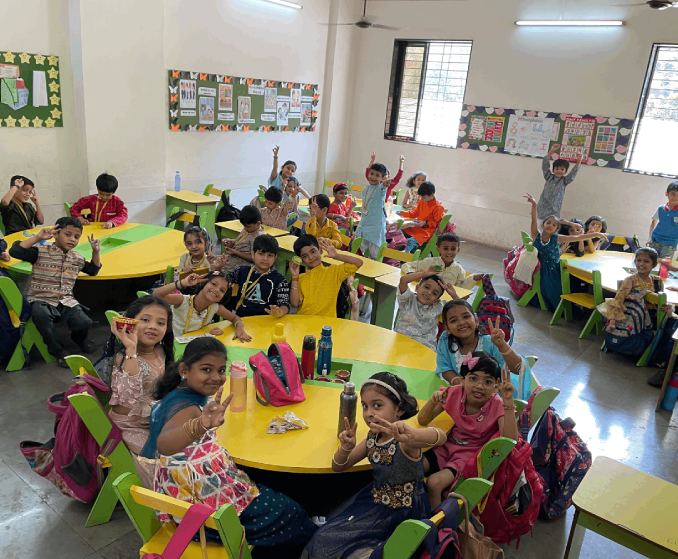
Education goes beyond textbooks and classrooms. We believe in empowering students to explore their passions challenge conventions.

Primary
In our curriculum structure, the content and the learning experiences are organized and integrated in a holistic way.
We ensure that the child learns through experiential learning, analyzing, reflecting, conceptualizing and applying the knowledge for deeper insight and long lasting learning.
Our school lays a lot of emphasis on the Language Development and promotes academic and social activities to enthuse critical and creative thinking and writing, events that encourages collaboration and coordination with peers throughout their learning years in school.
Subjects to be studied in Primary
| GRADES I AND II |
|---|
| ENGLISH |
| II LANGUAGE (HINDI OR MARATHI) |
| MATHEMATICS |
| ENVIRONMENTAL STUDIES |
| COMPUTER STUDIES |
| GENERAL KNOWLEDGE |
| VALUE EDUCATION |
| GRADES III TO V |
|---|
| ENGLISH |
| II LANGUAGE (HINDI OR MARATHI) |
| SOCIAL STUDIES |
| MATHEMATICS |
| SCIENCE |
| COMPUTER STUDIES |
| GENERAL KNOWLEDGE |
| VALUE EDUCATION |
Extra Subjects to be studied at Primary
Co-Curricular Subjects
| GRADES I TO V |
|---|
| PHYSICAL EDUCATION |
| MUSIC |
| DANCE |
| DRAMA |
| ART & CRAFT |
| MARTIAL ARTS |
Extra Curricular Subjects
| GRADES I TO V |
|---|
| RUBIK’S |
| CARROM |
| CHESS |
| BADMINTON |
| ATHLETICS |
| KHO KHO |
| FOOT BALL |
Scope Of Subjects At Primary

01. Languages ( English / Hindi / Marathi)
English /LANGUAGE in primary focuses on foundational literacy, basic sight words and simple sentence structure. We encourage children to build vocabulary and communication skills with objectives for reading, writing, speaking & listening. Basic grammar/punctuation, vocabulary, and comprehension using engaging texts like stories, poems, and informational pieces, all while fostering confidence and effective communication for daily use.
02. Mathematics
The curriculum aims at developing the necessary tools like Observation, Number analysis, Quantity recognition, Space perception, mathematical thinking and logical reasoning and to use the variety of mathematical tools in the learning and application of mathematics effectively and most important comfortably.
03. EVS/ Science
In Grades I and II, EVS covers areas of both Science and Social Studies in an integrated manner. Our expert team of teachers have put in a lot of efforts to develop and conceptualise Grade I & II EVS textbooks
The focus of the Science Curriculum is on skill and process development rather than content coverage. The curriculum encourages development of curiosity, analytical, critical thinking and synthesis of ideas and concepts.
04. Social Studies
It also throws light on each persons’ role in society and our subsequent interdependence on the society, awareness towards public and private property, constitution, right & duties of a citizen, functions of government and how it influences our life altogether.
05. Computer Education
A computer curriculum is a structured plan of computer science education, varying from basic digital literacy (hardware, software, and internet) for beginners. Preparing students with both theoretical knowledge and practical skills for general digital competence
The use of modern technology also equips children with necessary skills to learn different concepts in an enjoyable way and make learning fun.