

Secondary
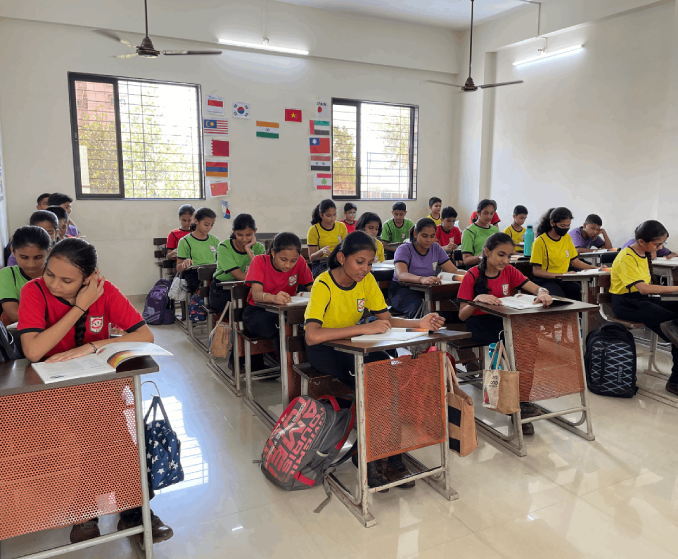
Education goes beyond textbooks and classrooms. We believe in empowering students to explore their passions challenge conventions.

Secondary
In our curriculum structure, the content and the learning experiences are organized and integrated in a holistic way.
We ensure that the child learns through experiential learning, analyzing, reflecting, conceptualizing and applying the knowledge for deeper insight and long lasting learning.
Our school lays a lot of emphasis on the Language Development and promotes academic and social activities to enthuse critical and creative thinking and writing, events that encourages collaboration and coordination with peers throughout their learning years in school.
Subjects to be studied at Secondary
| GRADES VI AND VIII |
|---|
| ENGLISH |
| II LANGUAGE (HINDI OR MARATHI) |
| III LANGUAGE( HINDI OR MARATHI ) |
| HISTORY / CIVICS |
| GEOGRAPHY |
| MATHEMATICS |
| GRADES VI AND VIII |
|---|
| PHYSICS |
| CHEMISTRY |
| BIOLOGY |
| COMPUTER STUDIES |
| VALUE EDUCATION |
| GENERAL KNOWLEDGE |
Extra Subjects to be studied at Secondary
Co-Curricular Subjects
| GRADES VI TO VIII |
|---|
| PHYSICAL EDUCATION |
| MUSIC |
| DANCE |
| DRAMA |
| ART & CRAFT |
| SUPW |
| MARTIAL ARTS |
Extra Curricular Subjects
| GRADES VI TO VIII |
|---|
| BADMINTON |
| ATHLETICS |
| KHO KHO |
| VOLLEY BALL |
| CHESS |
| CARROM |
Scope Of Subjects At Secondary

01. Languages (English / Hindi / Marathi)
Our curriculum aims at language development in order to enable students develop vocabulary relevant to their subjects, interpret assignment questions, respond with a well-structured and coherently presented assignments.
We ensure that our students are able to appreciate both fiction and non fiction texts, poetry as well as plays through our textbooks( Golden Glade – some popular poets and authors – Roald Dahl, O. Henry, Robert Brownng, T.K Narayanan, Sarojini Naidu, Hans Christian Anderson Twelfth Night, As you like it,Taming of the Shrew, Henry V). They are introduced to various narrative styles by giving them various texts to enable them to understand and appreciate the beauty of any literature.
Every student is required to read minimum of 4 story books appropriate to their age in a year and present book review of the same.
We conduct elocution, debate, group discussion that may include topics based on science, history, civics or geography
02. Mathematics
- Concrete and Semi abstract to Abstract
- Simple to Complex
- Individual concept to multiple concept.
In the Upper Primary Level the child tries a series of trial and error method to solve given problems thereby he/she learns to apply it into other situations and problems.
3. Science (Physics/ Chemistry/ Biology)
Our curriculum aims at developing the six domains of Science: Concepts, Processes, Applications, Attitudes, Creativity and Worldview (Nature of Science).
Science branches out into its three streams i.e Physics, Chemistry and Biology from the Upper Primary level
PHYSICS: It is the study of matter, energy and its interactions. It attempts to explain how nature works using the language of mathematics. Physics generates fundamental knowledge which is needed for the future technological advancements.
CHEMISTRY: Chemistry applies to various aspects of day to day life. Numbers of activities/experiments are done to show different chemical changes. By performing various experiments students develop scientific skills such as, observation, measurement, analysis, interpretation, drawing conclusions, etc.
BIOLOGY:It is perhaps the most fascinating of all the sciences, as it is the science of life, and is aptly called life science. Students learn about the two branches of Biology , Botany and Zoology in integration with each other.
Through our curriculum we try to enable students to learn to appreciate the diversity of life on earth, understand the flow of energy and matter in biological systems, interpret the process and outcomes of evolution ,appreciate interdependence of living things, learn the mechanisms of genetic inheritance and information flow.
LABORATORIES: Experimentation is an integral part of all the three branches of science. The well equipped Physics, Chemistry and Biology laboratories in school aims at enabling students to learn theories in a more elaborative manner with the involvement of its application. The school laboratory familiarizes students with experimental apparatus, students learn to make careful experimental observations and how to think about and draw conclusions from such data. Students verify the core concepts themselves in the lab by doing hands on experiment.
4. Computer Studies
Computers play a very vital role in our lives. Needless to say they play crucial role in education system too. Computer studies allow students to acquire sound knowledge and skills in using Information and Communications Technology to accomplish, communicate, facilitate activities and perform good research in various subjects.
The curriculum introduces students to various computer languages, Hardware components, advance features of HTML, Scratch programming, usage of variety of visual effects, Algorithms, Program coding ,development of App, ethics and safe measures adopted in computing world to name few.
We want our students to participate in the digital world constructively.
5. History
The scope of History curriculum is developed in a way that students assimilate the causes and effects of series of events that have happened and shaped the world that it is today. Through series of discussion students are able to comprehend the impact these events have had on mankind in its entirety and how it has changed forever the structure of civilizations, demography, idea of religion, geographical and political boundaries, cultures, lifestyles, etc. In a nutshell be aware of interdependence of various regions, local to global.
Through PPT, talks, documentaries, movies, field trips, excursions, role play, etc we try to help students know our past, stay relevant in present in order to shape better future.
CIVICS :
We strongly believe that from an early age if we help our students make connections with present day social fabric, economic development, political scenario of our country and how it affects our daily life, then we for sure will be able to build truly learned and responsible citizens.
Our curriculum help students comprehend how government functions and frame policies for the benefit of the citizens. We help students interpret interconnections among policies and systems and how policies affects our present life. To enable them to perceive this, mock parliament sessions and mock court sessions are held.
We also conduct field trips to old age homes and orphanages to help them develop sensitivity towards the less privileged ones. Students are also taken to different places of worship in order to make them be more accepting towards people across gender, caste, religion and nationalities.
Various projects are given to create awareness towards our rights as citizens of the country as well as our duties towards our society.
6. Geography
The curriculum of Geography is developed with an objective to make students understand the cause-effect relationships of natural phenomena and sensitise them about the need to conserve the natural resources, appreciate the interdependence of nations of the world and understand how climatic conditions influences man kind.
As part of the curriculum students are taught to record different elements of weather of a particular place, understand the working of natural phenomena like cyclones, pressure belts, winds etc. with the help of Google Earth and satellite imagery. They learn to make individual maps with colours and conventional symbols, find the directions with or without the help of GPS system, study weather stastics with the help of website like IMD.
The interest in the subject is developed by using different resources like multi-media, graphs, flowcharts, maps, working models, games, field visits, experiments, powerpoint presentation, documentaries, newspaper articles, project work, journals, magazines, etc.
7. Value Education
Teaching values through stories particularly Gita, it builds a strong moral compass, shapes ethical decision making and develops empathy in children.
8. Financial Literacy
Financial literacy is the mastery of money management, budgeting, debt, and investing. It empowers you to make informed decisions that prevent debt traps, avoid financial scams, and build long-term wealth
ICSE Class IX & X – Subject-Wise Scope of Syllabus
The Indian Certificate of Secondary Education (ICSE) curriculum is a comprehensive, balanced, and well-researched educational framework designed to build strong conceptual foundations in students. The syllabus for Class IX and Class X focuses on enhancing analytical skills, critical thinking, creativity, and practical knowledge.
The syllabus is structured to build a strong academic foundation while promoting holistic development. Subject-wise learning not only prepares students for board examinations but also equips them with skills necessary for lifelong learning.
GRADE IX & X
| GROUP I |
|---|
| ENGLISH (LANGUAGE) |
| ENGLISH (LITERATURE) |
| HINDI |
| MARATHI |
| HISTORY / CIVICS |
| GEOGRAPHY |
| GROUP II |
|---|
| MATHEMATICS |
| SCIENCE (PHYSICS, CHEMISTRY, BIOLOGY) |
| ENVIORNMENTAL SCIENCE |
| COMMERCIAL STUDIES |
| ECONOMICS |
| GROUP III |
|---|
| PHYSICAL EDUCATION |
| HOME SCIENCE |
| BASIC DATA ENTRY OPERATOR |
| CO-CURRICULAR SUBJECTS |
|---|
| S.U.P.W |
| MARTIAL ARTS |
GROUP I
01. English Language & Literature
The English syllabus aims to sharpen language skills, enrich vocabulary, and foster an appreciation of literature which enhances fluency and appreciation of multiple languages.
Grammar & Writing Skills: Creative and formal writing (essays, letters, Notice , Email ) to build effective communication.
Reading Comprehension: Passage-based questions to enhance understanding and interpretation.
Literature: Prose, poetry, and Drama that develops literary appreciation and analytical thinking.
Students become confident communicators with strong reading, writing, and critical analysis abilities.
02. Second Languages (Hindi and Marathi)
Grammar & Writing Skills: Creative and formal writing (Essays and letters) to build effective communication.
Reading Comprehension: Passage-based questions to enhance understanding and interpretation.
Literature: Prose and poetry that develops literary appreciation and analytical thinking.
3. History & Civics
History syllabus provides insights into past civilizations and events and Civics introduces democratic governance and civic responsibilities.
Instills historical awareness and responsible citizenship.Provides an understanding of the working of the Indian government necessary for the students to grow into responsible, enlightened citizens in a secular democracy and enrich the understanding of those aspects of Indian historical development which are crucial to the understanding of contemporary India
4. Geography
Explores Earth’s physical features, resources, and human–environment interaction and helps in developing geographical understanding and environmental consciousness.To know about the availability of resources, understand and appreciate the problems of development in India. The syllabus also helps students acquire practical skills related to the meaning and use of maps and their importance in the study of Geography.
GROUP II Elective
The subjects offered in Group II electives broaden understanding in specialised areas and support diverse career interests.
01. Mathematics
02. Science (Physics, Chemistry & Biology)
Syllabus for Science integrates all three disciplines to encourage inquiry-based and experimental learning.
It develop instrumental, communication, deductive and problem-solving skills. and prepares students for advanced science education and practical problem solving.
Laboratory work reinforces concepts and cultivates scientific methodology.
3. Commercial Studies
The syllabus enable students to develop a perceptive, sensitive and critical response to the role of business in a global, national and local context which provides an appropriate body of knowledge and understanding, and to develop appropriate skills as a basis for further study or work or both.
4. Economics
To acquire the knowledge of terms, facts, concepts, trends, principles, assumptions, etc. It develops knowledge of contemporary economic problems and students learn to appreciate the efforts being made to solve these problems. It enriches the students about various economic processes that help in improving our standard of living
5. Environmental Science
The subject deals with the interdependence of living things within their environment and provides an insight into the orderly interplay of factors influencing environmental change. The impact of human demands on renewable and non-renewable resources and the limited availability of these resources in nature, have been linked to correlate with patterns of human behaviour necessary to evolve a sustainable environmental paradigm.
GROUP III
01. Physical Education
It creates opportunities to develop ‘esprit de corps’, courtesy, sportsmanship, social skills, democratic conduct and ideals and develops appreciation of the aesthetic and cultural aspects of movement.
02. Home Science
To understand and appreciate the role of Home Science in the development and well- being of self, family and community.by developing understanding of basic concepts of food and nutrition in order to lead a healthy life, human development with respect to early and middle childhood, basics of Textiles and Clothing. And develop skills for effective management and utilisation of resources available.
3. Basic Data Entry Operator
It focuses on foundational computer skills, proficiency in office software, and accurate typing to prepare individuals for administrative and data management roles.